NOTE: Original article was written in german. Translation via Deepl Pro.
Smart glasses and facial recognition were already a reality ten years ago. Back then there was a big opposition against those gadgets, politically and socially.. That has changed – which is why these gadgets must be banned.
Just a few years ago, for many people the idea was unnerving of putting on a pair of glasses that provided additional information about objects and people. Google Glass, launched in 2012, was relatively quickly dubbed ‘glassholes’. Public and political opposition to these surveillance glasses became so intense that tech companies such as Meta shelved their plans. Google Glass led a lonely existence in logistics in a few warehouses, where it helped staff find the right parcels. It remains one of the few useful scenarios for smart glasses.
But why was this gadget so unpopular?
In the 2010s, the topic of AI was primarily just hype within the tech industry. Scientists warned of a great deal of ‘snake oil’ being peddled under the banner of artificial intelligence. Conceptually and technologically, facial recognition was one of the few more mature methods thanks to emerging deep learning technologies. Hardware and software worked in tandem, and the recognition functioned – yet the Zeitgeist was different.
Activists, politicians and data protection advocates in the West pointed the finger at China, where plans for a nationwide survey of every face – including a points-based system for behaviour loyal to the regime – had come to light.
Apart from white tech creeps from Silicon Valley, very few people were keen on the idea.
With the breakthrough of generative AI technologies in late 2022, something peculiar happened: with the help of chatbots, it suddenly became possible to generate text, images, videos and code. This caused great astonishment worldwide; at the same time, however, these tools suffered from ‘hallucinations’ due to probability calculations. So researchers and underpaid clickworkers in the Global South taught the tools how to interpret internet users’ prompts more accurately and truthfully. And two model generations later, the language models can be used to create one-to-one deepfakes of individuals.
This automatically brought facial recognition – which does not actually require generative AI architecture and has been functioning for years – back onto the political agenda. And it suddenly made it socially acceptable. This was because there was a growing desire to use AI not only to generate creative texts, but also to achieve accurate results. The more accurate, the better, more practical and more useful.
Millions of internet users are now gradually getting to grips with these new technologies, experimenting with agents that make purchases, book travel and sort out administrative tasks on their behalf. These are tasks that require precise answers. Now everyone recognises the benefits of accurate AI. And that is leading to a revival of smart glasses.
That this involves daily breaches of European and Swiss data protection laws? A minor detail.
Mark Zuckerberg can be pleased about this, having miscalculated by billions on several occasions in the past. Both the metaverse and the clunky virtual reality headsets that transported users to other worlds turned out to be massive flops.
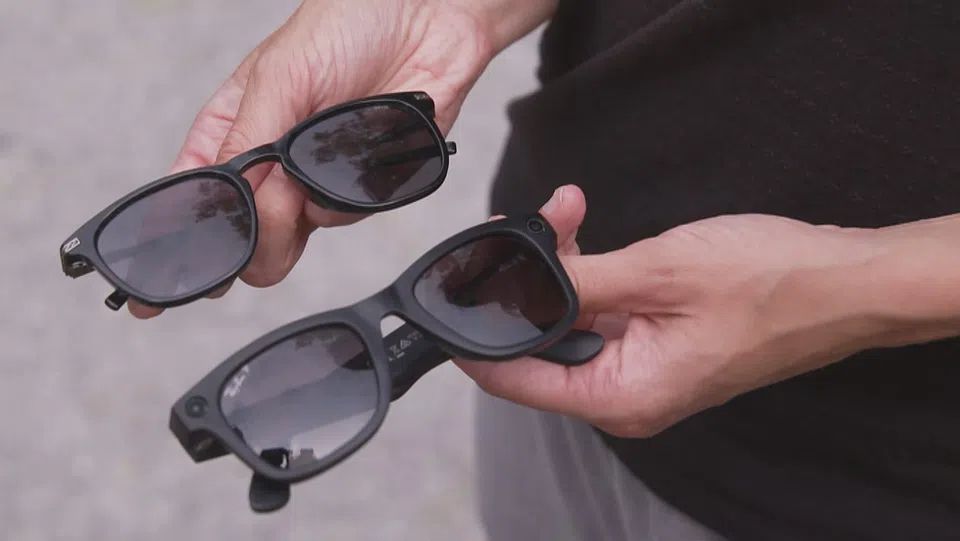
But now, with its investment and partnership with glasses manufacturer Ray-Ban, the Meta group has backed the right horse. This is partly because the social climate has also shifted in recent years: Zuckerberg has finally found his influencer clientele – the manosphere, which is set to help the accessory achieve a breakthrough – as well as the necessary social backlash for his products. Unsurprisingly, there is a growing number of headlines about women who are being recorded against their will and disparaged online.
The political climate is currently favourable for the IT giant due to the multipolar crises. For instance, the *New York Times* revealed an internal memo from Meta, which states verbatim: ‘We will launch the feature in a dynamic political environment where many civil society groups from whom we would expect attacks are focusing their resources on other issues.’
When it comes to data protection, the tech company shifts the responsibility onto the consumer. The small light on the edge of the glasses is intended to signal: ‘I’m filming you.’ End of discussion.
Meta has, in any case, already built the software code for facial recognition technology into the glasses; it just hasn’t been activated yet. Furthermore, Meta is working on the possibility of having the glasses’ sensors record continuously. All these new features are prohibited under Swiss criminal law (covert recording) and data protection law (right to one’s own image), as the Federal Data Protection Commissioner states in his guidance note on ‘Wearables’. ‘This “always-on” architecture destroys all privacy,’ writes Digitale Gesellschaft.
Yet this does not stop the sale of smart glasses.
From the perspective of the rule of law, there are three responses.
Firstly: a boycott. The best response would be if, as was the case ten years ago, there were hardly any demand, which would cause the supply to disappear again.
Secondly: digital self-defence. Apps such as ‘Nearby Glasses’ and ‘Antizuck’ are already available. These alert you if someone within a 100-metre radius is taking a photo (though they are also prone to errors).
And thirdly: a ban on the glasses, as called for by Campax and also Digitale Gesellschaft. Exceptions should be made for visually impaired people and for industrial use.
It is incredibly naïve to trust that a wearer of smart glasses will behave in accordance with the law and deactivate half of their functions. People will use whatever technology is available. Who, these days, asks all the hundreds of passers-by on Zurich’s Bahnhofstrasse for permission before taking a snap? Probably no one. But at least when a smartphone is pointed at you, you can still step out of the way or cover your face. Recording via smart glasses is unobtrusive, silent and covert. Everyone around is filmed, measured and eventually identified against their will – without ever knowing it.
According to the EU’s ‘AI Act’, real-time facial recognition is prohibited for private use. Consequently, these glasses would have to be banned, as the potential for misuse is built into their design. This is precisely what the German Centre for Digital Rights is calling for.
In Switzerland, the debate on red lines in AI regulation has only just begun. National Councillor Isabelle Chappuis asked in a parliamentary question what the Federal Council intends to do. A response is still pending.
However, the ban on private use should not serve as a justification for the state’s monopoly on the use of force.
Just under two years ago, the Federal Supreme Court issued a ban on scanning car occupants via cameras, which Digitale Zivilgesellschaft interprets as a national ban on biometric identification. Nevertheless, the cantonal police forces and the Federal Office of Police (Fedpol) are toying with the idea of facial recognition technologies (even though cities such as Zurich, Lausanne, St Gallen and the canton of Basel-Stadt have already passed a ban). The Zurich Cantonal Council has even granted the cantonal government a free pass to experiment with biometric facial recognition. And following riots at a Palestine demonstration, centre-right politicians called for the cantonal police forces to be equipped with facial recognition.
The police authorities in the German-speaking Swiss cantons are certainly rubbing their hands with glee as they read the latest headlines from their northern neighbour: Following the attack on Christopher Street Day, Baden-Württemberg’s Interior Minister Hagel is now calling for facial recognition in public spaces – in order to track down terrorists specifically.
Real-time facial recognition in public spaces triggers a mass screening of all faces. When a match is found, those faces light up, but everyone is scanned. And anyone wishing to track how the targets of surveillance are shifting in a Western country need only look to the US. There, the list suddenly no longer consists solely of female terrorists or missing victims of human trafficking who can be quickly located using AI, but also the entire opposition to the White House.
It is therefore utterly incomprehensible that media outlets such as SWR fail to put the following quote from Interior Minister Hagel into context, instead simply repeating it verbatim: “According to the Ministry, however, this is not about permanently monitoring everyone in public spaces. Rather, the AI software is intended to search specifically for certain individuals.”
The fact is: there is no such thing as targeted surveillance or a targeted search using facial recognition technologies. Just as one cannot be ‘a little bit pregnant’. All faces are always affected.
It is time, for once, to enshrine sensible bans and red lines in the Swiss Constitution. Facial recognition – whether private or state-run – is one of them.
Original article published here: https://www.republik.ch/2026/08/31/ctrl-das-gruselige-comeback-der-smarten-brillen
On my blog, I publish all the posts that I share across my various channels, either in full (original blog posts) or in abridged form (republik.ch). As I’m only employed part-time, I’m grateful for any support.
Anyone wishing to support my blogging activities is welcome to donate to the Techjournalismus.ch association’s bank account.
The aim is to continue expanding the editorial content of this blog in the future. With sufficient financial support, I will also be able to commission other journalists to carry out smaller research projects. I am grateful for every donation!
Techjournalismus.ch Association
CH36 0077 0255 9452 2200 1