New social networks from Europe, such as W Social and Eurosky, aim to do everything better: no bots, no disinformation and only European technology. But do they deliver a better digital future for us?
Note: my original article is written in german (I translated with deepl.com Pro and made a few edits)
One of the issues that has long been a concern for Brussels is digital dependency – and, consequently, Europe’s vulnerability to blackmail.
Sensitive health information, university records and a great deal of other data are being transferred to the data centres of American big tech companies due to the cloud requirements they impose. Whilst the EU aims to ensure the rule of law and free competition on the internet through its digital legislation, such as the ‘Digital Services Act’, these laws have now become part of the geopolitical power struggle and are being used as bargaining chips in the trade dispute with the US (as the US president recently has shown with the threat of 100% tariffs if the EU imposes a digital tax on big tech companies).
The Trump administration is stepping up the pressure on Europe and describing the ‘Digital Services Act’ as a ‘censorship law’: activists and EU politicians are being sanctioned, whilst diplomats are being instructed to take action against it. At the same time, tech companies are coming under pressure to disclose their communications with EU authorities – for example, to substantiate allegations of political interference. Consequently, the realisation has now taken hold within the EU: even the best laws are of no use without Europe’s own alternatives and the necessary infrastructure.
The European Commission has acknowldged those shortcomings and, on 3 June, presented the Tech Sovereignty Package: an initiative to promote more European data centres, more cloud infrastructure and more chip development.
However, it will take time for these investments to bear fruit.
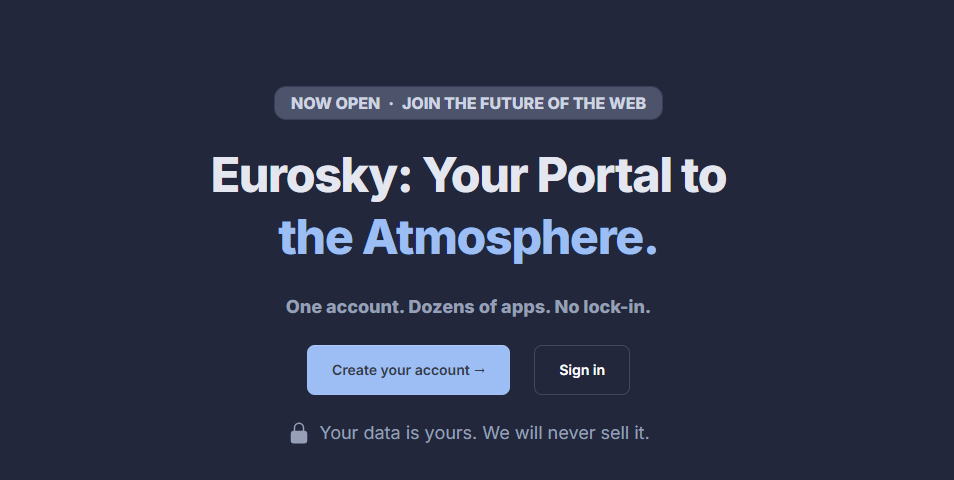
Two private initiatives are already much further along: W Social and Eurosky. They aim to implement EU laws such as the ‘Digital Services Act’ by design, thereby solving an urgent problem – namely that the digital public sphere takes place primarily on servers owned by American or Chinese corporations. And is consequently at the mercy of their legislation.
Both aim to do better than the American and Chinese platforms: no data misuse, no bots, no addictive algorithms, and no spread of hate, incitement or disinformation. They pursue similar goals but implement them differently – one commercially, the other non-profit.
Both are joining the Atmosphere ecosystem, which brings together many apps on the same infrastructure and to which the message service Bluesky also is part of. The underlying AT Protocol – unlike ActivityPub on the decentralised social media network Mastodon – allows the creation of a separate network or business model.
Both W Social and Eurosky operate their own PDS (jargon for: personal data server), on which user data is stored under European control, in compliance with the European General Data Protection Regulation (GDPR). Users of Bluesky, on the other hand, currently use servers in the US.
W Social is based in Stockholm, is hosted by the Finnish company UpCloud and is led by the German lawyer and former eBay head of data protection, Anna Zeiter, who lives in Switzerland. Zeiter aims to create a European digital public sphere that brings together media content and the pulse of European cities in news feeds. Local trending topics are supposed to be introduced soon as she told me some months ago.
The biggest point of criticism – and rightly so – concerns identity verification: to exclude bots, users must verify their identity using an ID document in a separate app. Most of the data is then to be deleted – only nationality and age are retained to comply with legal requirements and confirm that the user is of legal age.
However, a technical analysis by the tech blog ‘dnip’ shows that the app requires much more: a telephone number, an email address and date of birth, plus a photo of the passport or identity card (english version of the article here). This information is to be deleted once it has been verified. Zeiter points out that the concept was approved by the German data protection officer Louisa Specht-Riemenschneider, who sits on the company’s advisory board.
But why should anyone upload and entrust their passport details to a new start-up? The W Social CEO emphasises her platform’s unique selling point: a ‘Twitter without bots’, featuring only real people.
But particularly within the open Atmosphere ecosystem, the bot issue is probably not a particularly major threat anyway. There are no polarising filter algorithms here that reward anything that generates noise.
That said sooner or later W Social intends to register to be part of the digital identity infrastructure of the EU and Switzerland, meaning users will only need to prove they are over 18 years of age. The company has confirmed this in response to a media request from me.
Eurosky, a non-profit initiative of the Dutch Modal Foundation, is thinking on a larger scale and making better use of the advantages of open protocols. The Eurosky account is designed to allow users to log in to many applications (such as the newly launched Mu Social). Furthermore, the creators of Eurosky are planning a different form of verification process that does not require ID checks.
Together with Mastodon, Eurosky is promoting the ‘European Social’ declaration for new European social networks – decentralised, interoperable and open source. The emphasis on open source reads as a dig in the direction of the profit-oriented W Social, which has so far received significantly more media attention.
This is certainly also down to the marketing and influencer work, which is remarkable at W Social: the American-Polish journalist Anne Applebaum has already migrated to W Social, as has the investigative journalism network OCCRP. EU Commission President Ursula von der Leyen is also promoting the upcoming network. From a Swiss perspective, it is also interesting to note that the former Chief of the Swiss Armed Forces, Thomas Süssli, is part of the advisory board.
W Social appears to be supported primarily by the European establishment.
The business model remains unclear to me: options range from context-based advertising to cooperation with European media. There is scepticism, however, about how W Social intends to handle user data in future. Blogger and Decentralisation Expert Elena Rossini has criticised the fact that there has recently been talk of ‘high-quality data’ and its use for training AI models.
At present, the added value of W Social and Eurosky compared to platforms such as Bluesky is still limited. Both initiatives are a promise for the future.
The key to a breakthrough is unlikely to depend on how much European values such as open source and privacy are incorporated into the technical architecture – otherwise Mastodon would have reached a mass audience long ago. What matters more is the extent to which the tech oligarchs Elon Musk and Mark Zuckerberg are pushing their own customers away: through toxic content, propaganda and an ever-deteriorating user experience.
Tech blogger Cory Doctorow calls this process enshittification. And Big Tech reliably provides illustrative examples of this.
So the irony is: Meta, Google and TikTok themselves provide probably the best marketing arguments for European alternatives.
👀 These clicks are worth it
- ‘Netzpolitik.org’ and Bayerischer Rundfunk have once again come up with a new revelation regarding the data broker trade: it is not the US ICE agency, nor the Egyptian secret service, that are buying location data from citizens – but two German federal states!
- Zimbabwean peace researcher Ishmael Bhila explains in a must-read WOZ interview why AI does not make warfare more efficient or humane, but simply faster. And why we are still a long way from an international consensus on autonomous weapons systems.
- Renowned tech journalist Karen Hao explains in an interview with Republik why OpenAI and Anthropic are on the wrong track with their mantra of ‘scale, scale, scale’ – meaning more data centres, faster chips and even more data. And she advises the EU: Be creative – and don’t copy Silicon Valley.
- Ethicist Dorothea Baur argues in her blog post that data centres are part of a business model that, at every stage, extracts more than it creates. What does society get in return? Spoiler alert: very little, for the time being.
- My colleagues Philipp Albrecht and Dennis Bühler describe, in their annual review of the media industry, bizarre scenes from Swiss newsrooms: for example, AI-enthusiastic bosses at Swiss media publishers who almost force journalists to use AI tools. Otherwise, they would be replaced.